Skip to Content
Home
Coaching
Workshops
IEP Advocacy
About
Contact
Pricing
Book Recs
Neurodiversity Labs
0
0
0
0
Home
Coaching
Workshops
IEP Advocacy
About
Contact
Pricing
Book Recs
Neurodiversity Labs
Home
Coaching
Workshops
IEP Advocacy
About
Contact
Pricing
Book Recs
Presentation title slide reading “Compassionate Pedagogy for Neurodivergence: Celebrating Difference & Promoting Equal Opportunities in Higher Education,” presented by Bird Sellergren of Neurodiversity Labs, with colorful curved stripes and a red abs
Today's Agenda slide listing Terminology, Adapting the Environment, Universal Design for Learning, and Inclusive Language.
Graphic explaining neurodivergent versus neurodiverse, stating that 20% of people in the U.S. have been diagnosed with a form of neurodivergence and more may be undiagnosed.
Neurodiverse graphic defining neurodiversity as neurological diversity within a group of people, with colorful stripes and starburst designs.
Educational graphic defining neurodivergence and listing autism, ADHD, dyslexia, Tourette syndrome, TBI, OCD, and other conditions.
Infographic titled “Neurodivergence in Postsecondary Education” explaining campus stigma and accessibility challenges that can reduce neurodivergent students’ success compared with neurotypical peers.
Graphic stating that institutional expectations of students may be implicit and exclusionary, and that disabled students often experience gaslighting and neglect when seeking classroom accessibility needs.
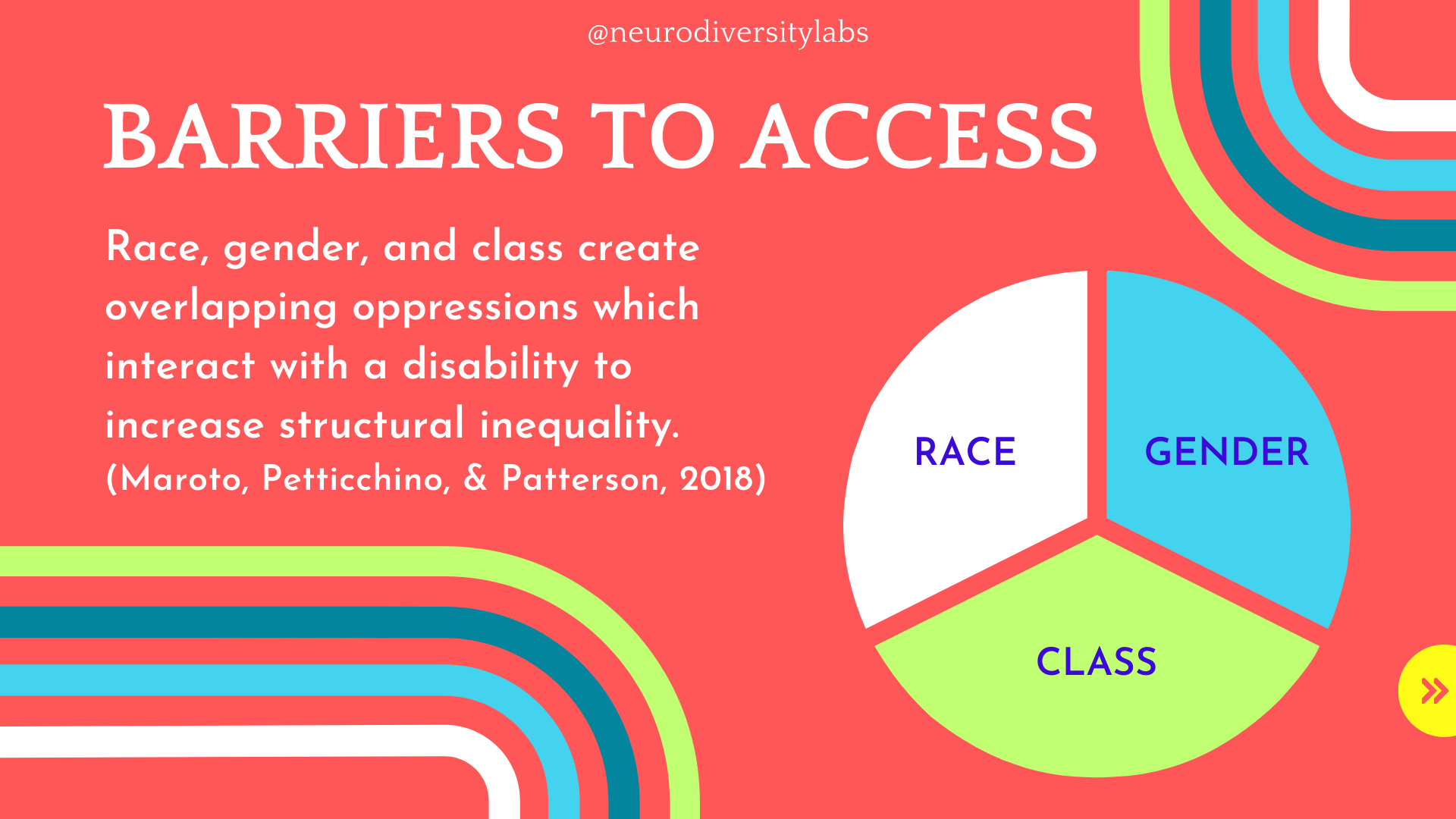
Barriers to access infographic explaining how race, gender, class, and disability create overlapping structural inequalities.
Graphic explaining that disability services, IDEA, and the ADA do not cover all accommodations; services are the floor, not the ceiling, and students may need more support.
Educational infographic: “Educators Can Improve Inclusion” with three strategies—adapt the environment for various needs, apply Universal Design for Learning, and use inclusive language—for neurodivergent students.
Colorful infographic titled “Adapt the Environment” about creating low-anxiety learning environments and adapting communication to support student success, with rainbow and star graphics.
Multi-modal communication graphic explaining that auditory or visual processing and working memory issues can make information retention and note-taking difficult for some neurodivergent people, with a recommendation to use multiple communication sty
Educational infographic titled “Multi-Modal Communication” with classroom accessibility strategies, including visual and oral presentations, written instructions, advance materials, lecture recording, and presentation copies.
Colorful infographic titled “Multi-Modal Communication” explaining preferred communication methods outside the classroom, including email, in-person conversation, video chat, and messenger.
Educational slide titled “Be Explicit About the Expectations of Students,” emphasizing connections between course material and learning outcomes, explaining nonliteral language, and recommending real-life examples.
Universal Design for Learning infographic explaining inclusive teaching that accommodates all students' needs, abilities, and learning styles.
Graphic stating that universal design for learning supports neurodivergent students, who face higher rates of anxiety, depression, suicidal ideation, and suicide attempts, and promotes positive mental health and student success.
Educational graphic about acknowledging student differences and strengths, encouraging consideration of underlying reasons for behavior and avoiding neuro-normative assumptions about neurodivergent students.
Educational graphic about acknowledging student differences and strengths, suggesting group-work roles that leverage organization, attention to detail, and digital skills.
Active listening infographic encouraging compassionate clarification, empathetic support for neurodivergent students, and awareness of implicit bias and stigma.
Active listening infographic about recognizing sensory overwhelm and anxiety and offering accommodations such as ear covers, sunglasses, breaks, and hybrid or online classes.
Inclusive language infographic explaining how to avoid pathologizing language about neurodivergence, including functioning labels, illness-based terms, and normal-versus-abnormal language.
Inclusive language graphic advising people to follow a student's language preferences when discussing disability or support needs.
Graphic explaining compassionate pedagogy as an adaptive process that supports neurodivergent students through inclusive learning environments, with colorful rainbow lines.
Presentation conclusion slide stating that proposed solutions are only a beginning for addressing barriers faced by neurodivergent students in postsecondary education, with a colorful abstract starburst and wavy background.
Thank-you slide presented by Bird Sellergren of Neurodiversity Labs, featuring colorful retro stripes and the website neurodiversitylabs.com.